Cold Case: Prosecuting the Phantom Thermostat Adjuster in American Shared Spaces
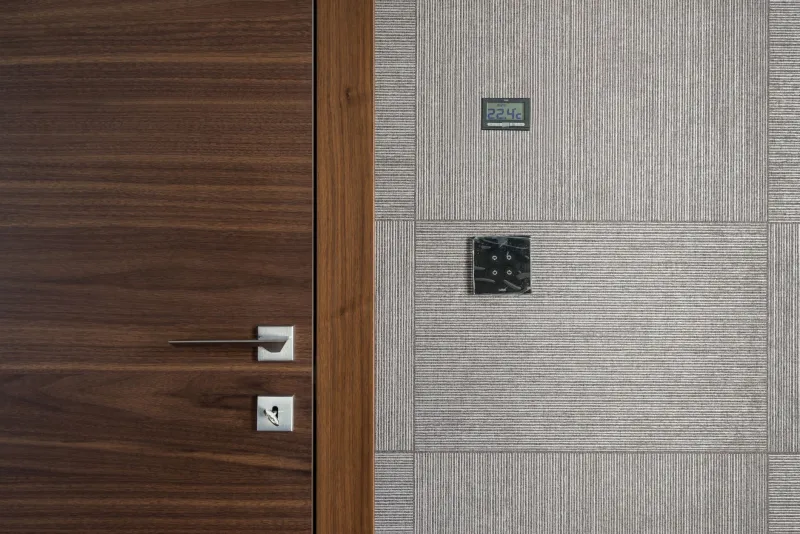
Somewhere between 68 and 74 degrees Fahrenheit lies a no-man's-land so contested, so soaked in passive-aggressive Post-it notes and icy stares, that military historians would recognize it immediately. It is not a border dispute. It is not a trade negotiation. It is the office thermostat wall, and it has claimed more workplace relationships than any HR incident ever documented.
We at Pontifications have reviewed the evidence. We have interviewed the victims. We have studied the crime scenes — the conference rooms that smell faintly of desperation and cardigan wool — and we are prepared to deliver our findings.
Article I: The Right to Not Freeze to Death
Let us begin with a foundational principle that has somehow escaped codification in American law: no person, having entered into a shared workspace or dwelling, shall be subjected to temperatures that require them to wear a parka indoors. And yet. Here we are. Every January, in office buildings from Duluth to Dallas, someone cranks the air conditioning to a setting that would make a penguin uncomfortable, and no one can figure out who did it.
The phantom adjuster is a creature of remarkable stealth. They operate at the margins of the workday — early mornings, late afternoons, the eleven minutes during which everyone is in a mandatory all-hands meeting about Q3 synergies. They touch the dial. They vanish. And they leave behind a population of shivering colleagues who are now googling whether hypothermia can be considered a workers' comp claim.
The maddening part is not the cold itself. It is the deniability. Ask around any open-plan office about who touched the thermostat and you will receive the same response you'd get if you asked who ate Karen's labeled lunch from the break room fridge: a wall of silence so complete it could be used as insulation.
Article II: The Testimony of the Perpetually Warm
In the interest of journalistic fairness, we must acknowledge the other side of this litigation — the warm-blooded among us, the human radiators who walk into a 74-degree room and immediately begin loosening their collars like they've just stepped off a bus in Phoenix in August.
These individuals are not villains. They are, in their own way, suffering. Their suffering is simply invisible to everyone around them because they are the ones touching the thermostat.
The perpetually warm operate on a logic that is internally consistent but socially catastrophic: if they are hot, everyone must be hot, and therefore the air conditioning is a public service rather than an act of aggression. This is the same reasoning used by people who play music out loud on public transit. Technically a perspective. Objectively wrong.
Science, for what it's worth, has weighed in. Studies have shown that the standard office temperature of 70 to 72 degrees was calibrated decades ago using metabolic rates of a 40-year-old, 154-pound man — a standard that, much like the 40-hour workweek and the open-plan office itself, has not aged particularly well. This means the thermostat wars are not merely interpersonal. They are structural. They are, in the truest sense, a systemic issue.
We raise this not to excuse the phantom adjuster, but to provide context for the jury.
Article III: The Apartment Clause — Domestic Temperature Jurisprudence
If the office thermostat is a civil dispute, the apartment thermostat is a constitutional crisis.
Roommate agreements — those optimistic documents drafted in the glow of a new lease signing, full of reasonable language about dish rotation and guest policies — almost never include a temperature amendment. This is a catastrophic oversight. Because at some point, usually around the first October, one roommate will turn on the heat and another will open every window simultaneously, and the apartment will become a philosophical statement about the nature of compromise rather than a habitable living space.
Married couples, of course, have refined this conflict into something approaching performance art. The negotiation is no longer about degrees. It is about who controls the narrative. One partner sets the thermostat to 68. The other adjusts it to 72 while the first is in the shower. By morning, no one has slept, the electric bill is a horror show, and both parties are drafting internal memos about respect and consideration that will never be delivered aloud but will absolutely inform the next five arguments about something unrelated.
Therapists call this displacement. We call it Tuesday.
Article IV: Proposed Remedies and Sentencing Guidelines
After extensive deliberation, Pontifications is prepared to offer the following recommendations to a suffering public:
The Consensus Clause: No thermostat adjustment in a shared space shall be made without a quorum. A quorum is defined as more than half the people currently in the room. A Slack poll does not count. A Slack poll is how you end up with a thermostat set to 71.3 degrees and four people who feel unheard.
The Posted Notice Requirement: Any person wishing to adjust the thermostat must leave a written explanation. "I was warm" is not an explanation. "I was warm" is a confession.
The Cardigan Compact: Cold people shall be permitted to add layers without comment. Warm people shall be permitted to remove layers within the bounds of local ordinance. Neither party shall weaponize their comfort level as evidence of the other's unreasonableness.
The Escalation Protocol: In the event of repeated unauthorized adjustments, the thermostat shall be placed behind a locked cover, the key to which is held by a neutral third party — ideally someone who works remotely and has no stake in the outcome.
Closing Argument
The thermostat is not really about temperature. It never was. It is about the oldest human question: who gets to decide? Who holds the dial in a space we share? Whose comfort is the default, and whose is the exception?
These are not small questions. They are the questions that built democracies, sparked revolutions, and generated an unknowable quantity of passive-aggressive notes taped to HVAC units across this great nation.
We do not have final answers. But we do have a recommendation: before you touch that dial, look around the room. Consider the people in it. Consider the sweater they brought specifically because of you.
And then, perhaps, leave it alone.
Court is adjourned.