Popcorn, Darkness, and the Sacred Covenant: A Judicial Review of Movie Theater Common Law
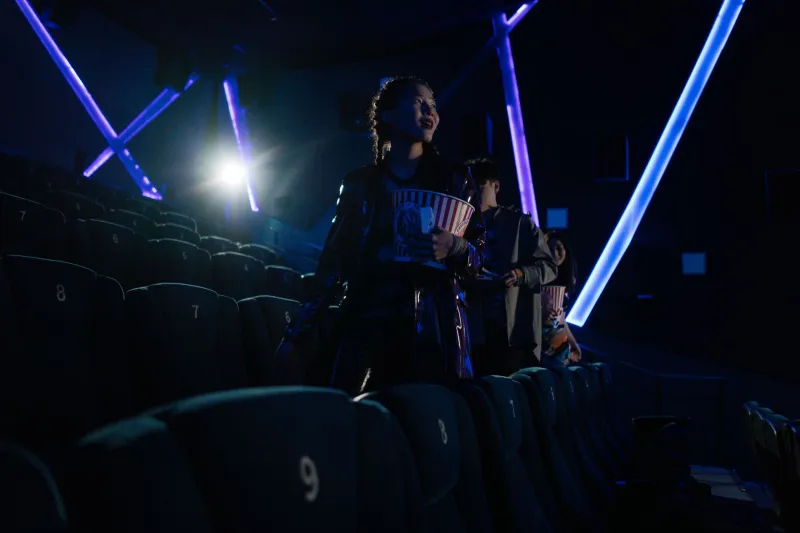
The United States Constitution is, by most accounts, a fine document. Four pages, a handful of amendments, a lot of wigs involved in its creation. And yet, for all its majestic authority, it says absolutely nothing about what you are supposed to do with your armrest when a stranger sits down beside you in a darkened AMC multiplex. This is a failure of governance that historians have, inexplicably, declined to address.
Fortunately, the American people — bless their overpriced-soda-clutching hearts — have filled this legislative vacuum themselves. Over generations of Saturday matinees and midnight premieres, a body of Common Law has emerged from the collective conscience of the moviegoing public. It is unwritten. It was never debated in committee. And it is, arguably, more rigorously enforced than anything currently stalled in the Senate.
This publication hereby convenes the High Court of Cinematic Conduct to issue its long-overdue ruling.
Article I: The Doctrine of Armrest Jurisdiction
Let the record show that a standard movie theater row provides two armrests for every two seats, which sounds equitable until you do the math and realize that each seat is bordered by two armrests, creating an immediate constitutional crisis that has destroyed friendships since the invention of stadium seating.
The Court holds, consistent with precedent established in Everyone's Instinct v. The Guy Who Just Grabbed Both, that armrest allocation shall be governed by the Doctrine of First Reasonable Occupancy. He or she who arrives first and claims an armrest in good faith shall retain sovereign jurisdiction over said armrest for the duration of the feature presentation, including previews but excluding the pre-preview slideshow of trivia questions, which no one has ever willingly watched.
The Court further notes the existence of a customary easement: the aisle seat occupant surrenders the outer armrest as compensation for their superior legroom and emergency egress privileges. This is not negotiable. There will be no dissent entertained on this point.
Dissenting Opinion, filed by J. Recliner: "I got here first and I want both. Also I'm going to put my seat back immediately before the lights even dim."
The dissent is noted and summarily dismissed.
Article II: The Phone Illumination Prohibition and Its Limited Exceptions
Perhaps no provision of Movie Theater Common Law has generated more litigation — most of it conducted in furious whispers — than the absolute prohibition on illuminated phone screens during a feature film.
The prohibition is total. The prohibition is sacred. The prohibition dates to a time before smartphones, when the equivalent offense was someone's Casio watch alarm going off during the tense third act of a thriller, and the social consequences were equally severe.
The Court acknowledges, however, that modern life has introduced complexity. We therefore codify the following narrow exceptions under the Emergency Notification Clause:
- A babysitter has texted. You may check your phone. You may not respond at length. You may not read the babysitter's three previous messages about whether the kids can have more screen time.
- You are a physician on call. The Court is sympathetic. Please step into the hallway.
- You simply want to check the time. This is not an emergency. The movie will end when it ends. You agreed to this when you bought the ticket. The ticket was fourteen dollars. Sit with your choices.
The practice of holding one's phone below seat level as though the angle somehow renders a glowing rectangle invisible is hereby classified as a legal fiction and shall not be recognized by this Court.
Article III: The Popcorn Timing Compact
The consumption of popcorn is not merely permitted in a movie theater — it is essentially the entire cultural point. The popcorn is the ritual. The popcorn is the sacrament. The Court has no objection to popcorn.
However, the Court takes judicial notice of a behavioral pattern that can only be described as an act of aggression: the individual who waits until the theater falls into its most profound silence — the hushed moment before a revelation, the held breath before a kiss — to plunge their entire forearm into a bag of popcorn and excavate its contents with the subtlety of a backhoe operator.
The Popcorn Timing Compact, ratified by informal consensus at every theater in America, holds that vigorous popcorn retrieval shall be synchronized with moments of high audio output: explosions, musical swells, comedic dialogue. This is not difficult. This requires only the barest flicker of social awareness. The Court believes in you.
Article IV: The Reserved Seat Squatter Problem and the Ancient Right of Confrontation
With the advent of reserved seating — perhaps the single greatest improvement to the cinematic experience since the invention of sound — one might have assumed that the era of the Seat Squatter would come to a close. One would be wrong.
The Squatter arrives early. The Squatter spreads coats across three seats. The Squatter looks at you with the serene confidence of someone who has never, not once, considered that their behavior might be inconvenient to other humans.
Common Law is unambiguous here. Your reservation constitutes a property interest. You have standing. You may, with all due courtesy, inform the Squatter that they are in your seat. The Court notes that approximately 94% of Americans would rather saw off their own arm than do this, which is why the Squatter continues to thrive as a species.
The Court cannot compel confrontation. The Court can only observe that the alternative — spending two hours of Dune: Part Whatever wedged into an aisle seat you didn't pay for — is a form of self-inflicted injustice that even the most activist judiciary cannot remedy.
The Court's Closing Remarks
What makes Movie Theater Common Law remarkable — what elevates it above the statutes and ordinances that govern more mundane aspects of American life — is that it functions almost entirely on the honor system. There is no enforcement mechanism. The ushers are seventeen years old and primarily concerned with not spilling the butter dispenser on themselves. The Court has no bailiff.
And yet, the vast majority of Americans, the vast majority of the time, comply. They silence their phones. They moderate their popcorn. They negotiate the armrest situation with the quiet diplomacy of seasoned ambassadors. They do this because they understand, on some cellular level, that the movie theater is a shared space — a collective agreement to sit in the dark together and feel things in public, which is, when you think about it, one of the stranger and more beautiful things human beings do.
The Court is moved.
The Court is also reminding you that talking during the movie is a capital offense under provisions we didn't have time to cover today. Term limits on this behavior will not be considered.
This opinion was delivered from the back row, center seats, which the Court had the foresight to reserve online three days in advance.