Thirty Thousand Feet of Lawlessness: The Case for an Armrest Constitution
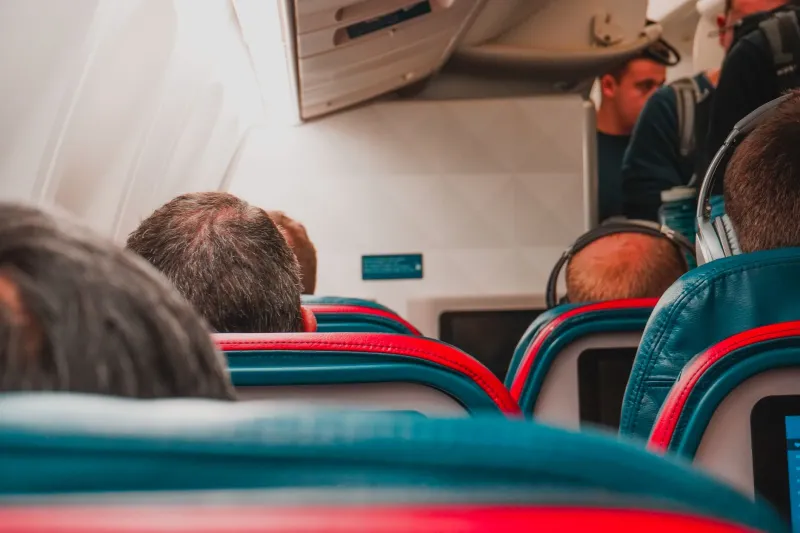
Every day, millions of Americans board commercial aircraft and enter a jurisdiction where no law governs the most contested strip of plastic in the known world: the shared armrest. We have constitutions for nations, bylaws for homeowners associations, and terms of service for apps nobody reads — and yet the armrest remains a wild frontier. It is time, fellow travelers, to convene.
Consider the scene. You have paid for a seat roughly the width of a standard envelope. You are hurtling through the stratosphere in a pressurized metal tube, breathing recycled air and eating a bag of pretzels that contains, by my count, eleven pretzels. And now the person in 14B — a stranger, a fellow citizen, a human being who presumably has a family that loves them — has colonized the shared armrest with the casual confidence of a 19th-century land baron. No treaty. No discussion. No referendum.
This is a civil rights issue. And we have ignored it long enough.
We Hold These Truths to Be Self-Evident (But Apparently Not)
Let us begin with the foundational principle upon which any fair armrest doctrine must rest: the middle seat passenger has suffered enough.
The window seat offers a view, a wall to lean against, and the psychological comfort of a clearly defined personal border. The aisle seat provides freedom of movement, early access to the overhead bin, and the ability to stand up without performing a full theatrical production involving five strangers' knees. The middle seat offers nothing. No view. No wall. No dignity. It is the punishment seat — the civic penalty box of commercial aviation.
And so we propose the First Amendment of the Armrest Constitution: Both armrests adjacent to the middle seat shall be considered the sovereign territory of the middle seat occupant, by right of compensation for suffering endured. This is not generosity. This is reparations.
Article I: The Doctrine of Established Possession
Precedent matters. In the landmark case of Kowalski v. The Guy in 22C Who Just Got On, the plaintiff (window seat, arrived first, arm already resting) argued that prior occupancy constitutes a legitimate claim to armrest territory. The defendant contended that boarding after someone does not extinguish one's natural right to elbow placement.
The Pontifications Constitutional Convention rules in favor of the plaintiff, citing the Doctrine of Established Possession: if an arm is already resting on an armrest at the time of a second party's arrival, that claim is valid and shall not be disturbed without mutual negotiation or the exchange of a snack item of recognized value.
However — and this is critical — the Doctrine of Established Possession does not apply when the possessing party has spread beyond the armrest into neighboring airspace. Elbow sovereignty ends at the armrest's edge. There is no manifest destiny at altitude.
Article II: The Creep Amendment
We must address the phenomenon known informally as The Creep — the slow, incremental expansion of one passenger's arm across the armrest boundary, typically executed over a period of forty-five minutes in increments small enough to maintain plausible deniability.
The Creep is cowardly. The Creep is undemocratic. The Creep is, frankly, impressive in its audacity, but it cannot stand.
The Second Amendment of the Armrest Constitution therefore establishes the Anti-Creep Clause: any territorial expansion achieved through incremental encroachment rather than open negotiation shall be considered null and void. The encroaching party may be subject to a meaningful but non-aggressive corrective elbow — defined as a single, firm repositioning not to exceed two inches — administered without eye contact, as is the custom of our people.
Article III: The Armrest Timeshare Proposal
For those situations in which two passengers of equal standing — say, two aisle-adjacent seat holders — find themselves in legitimate dispute over a single shared armrest, the Convention proposes the Timeshare Framework.
Under this framework, the armrest shall be divided into rotating intervals of no less than twenty minutes each, with transitions occurring naturally during beverage service, turbulence, or any moment when both parties reach for their phones simultaneously and accidentally make eye contact. At that point, the armrest resets to neutral, and the next occupant claims it through the ancient rite of whoever puts their arm down first.
This is not a perfect system. Democracy rarely is.
Article IV: The Flight Attendant as Supreme Court
No constitutional framework functions without an enforcement mechanism. We therefore propose that flight attendants — already performing the Herculean labor of managing the collective anxieties of two hundred strangers while demonstrating a seatbelt operation to people who have flown forty times — be recognized as the Supreme Court of Armrest Disputes.
Their rulings shall be final. Their word shall be law. And in exchange for this additional burden, passengers shall tip them spiritually, if not financially, and stop pressing the call button to ask for a second ginger ale before the cart has even reached row twelve.
A Bill of Rights for the Beleaguered Traveler
Beyond armrests, the Convention acknowledges additional grievances worthy of constitutional protection:
- The Right to Recline Negotiation: No seat shall be reclined more than halfway without a brief over-the-shoulder acknowledgment to the passenger behind you, who is currently eating a full meal and would like to keep their soup inside the cup.
- The Right to Window Shade Consensus: The window passenger controls the shade, but not unilaterally. When four rows of people are trying to watch a movie and you open the shade to stare at clouds, you are governing without the consent of the governed.
- The Freedom from Unprompted Life Stories: You have the right to silence. Your seatmate has the right to talk. These rights are in tension, and the Convention encourages the use of headphones as a peaceful diplomatic solution.
Ratification and Next Steps
The Armrest Constitution will not ratify itself. It requires the will of the people — or at minimum, the will of people who have been stuck in a middle seat between two elbow-first passengers on a four-hour flight to Phoenix and have had enough.
We call upon the airlines, the FAA, and at minimum one very motivated Reddit moderator to take up this cause. We call upon fellow travelers to study these principles, commit them to memory, and apply them with the quiet confidence of someone who knows they are right but has chosen, for the peace of the cabin, not to make it weird.
The frontier of the armrest need not remain lawless. We have the framework. We have the grievances. We have, crucially, nothing but time between here and our connecting flight in Denver.
The Convention is in session. Please return your tray tables to their full upright and locked position.